


Explore MAD Arts
Get Tickets
MAD Arts
481 S Federal Hwy, Dania Beach, FL 33004
DEADLINE TO APPLY: June 7
Please note that this program is completely free. We want to ensure broad access and create opportunities for as many people as possible. Due to limited seating, all applications will be reviewed, and selected participants will receive a confirmation email if accepted into the program.
Vibe Coding and Worldbuilding with AI Tools is a 5-day, practice-based research workshop that positions worldbuilding as both a creative method and an analytical lens for examining contemporary AI conditions—automation, synthetic media, misinformation, algorithmic influence, and ethics.
The program aims to demystify these topics by approaching them through applied inquiry: participants study key concepts and then put them into practice through participatory design, rapid prototyping, and iterative testing.
The workshop functions as an on-site laboratory focused on spatial and technical prototyping, including experiments with sound, projection, holographic display objects, networked systems, and visitor flow. It is designed as a scaffolded learning-intensive course that integrates theory with making.
Daily modules introduce foundational frameworks in worldbuilding, game design, experience design, and creative technology, paired with structured studio time, critique, and playtesting. Participants also develop applied AI fluency through creative workflows, including natural-language programming (“vibe coding”) and introductory agentic AI practices, as tools for building interactive media.
The program culminates in work that will be part of Dead Internet Museum’s Last Human Collective, featured in an exhibition opening on October 1, along with a final presentation and reflective debrief. Outcomes include AI literacy, design literacy, and portfolio-ready work, as well as research insights that feed directly into the evolving installation.
Audience: Ages 18+
Context
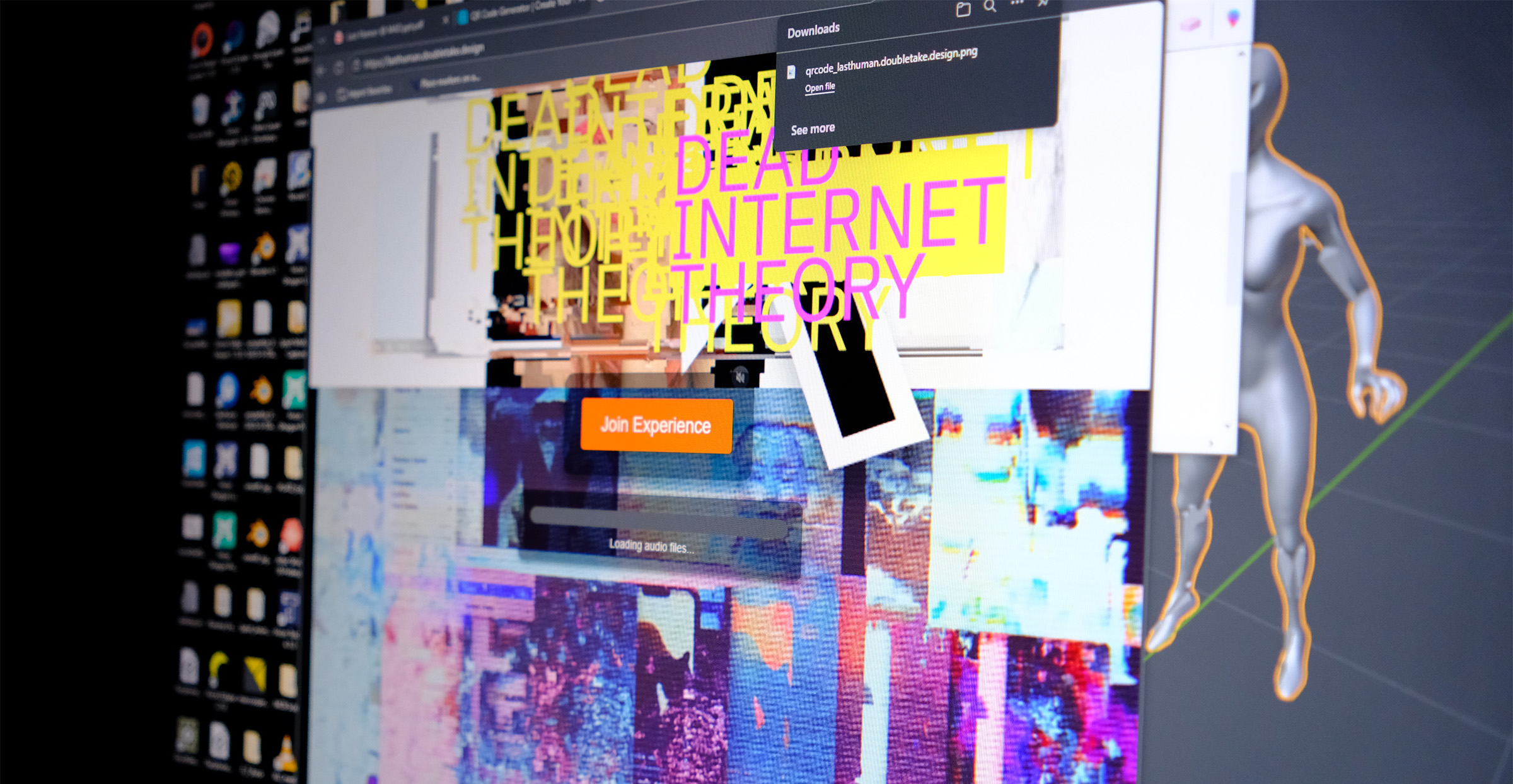
Participants are invited into the live development of Dead Internet Museum, a new prototype by the Columbia Digital Storytelling Lab, premiering at MAD Arts on October 1, 2026.
Built as an evolving participatory experience, the project explores urgent questions around synthetic media, misinformation, algorithmic influence, and the future of trust. These programs mix theory and practice—participants don’t just learn about AI; they build with it.
Through worldbuilding and hands-on prototyping, participants gain practical AI literacy skills, including vibe coding (coding with natural language) and agentic AI workflows—leaving with tools, insight, and creative confidence applicable to their own work.
Framework
Developed by Columbia University School of the Arts’ Digital Storytelling Lab, Dead Internet Museum by Last Human Collective is an immersive, participatory prototype —part exhibition, part interactive system. Audiences encounter synthetic media, misinformation, and algorithmic feedback loops that shape perception, memory, and social behavior.
The project integrates arts and humanities methodologies with creative technology to cultivate AI literacy through experiential engagement: participants learn by making, testing, and reflecting within a designed world.
Structure
A 5-day intensive combining daily learning modules (theory + frameworks) with hands-on building inside the Last Human / Dead Internet Museum environment. The program culminates in a public pop-up exhibition on Day 5.
Day 1 — World Foundations
World rules and tone (decay, signal/noise, unreliable truth). Build initial exhibit modules and conduct walkthrough tests. Introduction to vibe coding and worldbuilding with AI tools.
Day 2 — Play + Game Design
Participation mechanics (cooperation, deception, prompts, pacing). Rapid playtests; refine rules and facilitation cues.
Day 3 — Experience Design
Flow, transitions, and emotional arc (A → B). Connect modules into a coherent visitor journey.
Day 4 — Creative Technology
Integrate projection, sound, holograms, and local network behaviors. Full walkthrough tests with timing and reset modeling.
Day 5 — Installation + Public Exhibition
Install, refine, and finalize run-of-show. Public pop-up exhibition followed by a post-show debrief with documented learnings for the fall exhibition.


Lance Weiler
Lance Weiler is a Professor of Professional Practice at Columbia University and Director of the Columbia University School of the Arts’ Digital Storytelling Lab. A pioneer in immersive and participatory narratives, his groundbreaking projects—The Last Broadcast, Frankenstein AI, Sherlock Holmes & the Internet of Things, and Where There’s Smoke—explore the intersection of storytelling, technology, and human experience. His work has been presented at Sundance, Tribeca, Lincoln Center, and the World Economic Forum. Weiler serves on the Peabody Awards’ Interactive Board and regularly lectures at global institutions, including Harvard, MIT, and the United Nations.
Nick Fortugno - Director of the Digital Game Development Program, City College of New YorkNick Fortugno is a designer of games and interactive narrative experiences and the Director of the Digital Game Development Program at City College of New York. He has served as lead designer on acclaimed projects, including Diner Dash, Ayiti: The Cost of Life, and Breaking Bad: The Interrogation, and co-created Frankenstein AI with Weiler and Rachel Ginsberg. Fortugno is also co-founder of the Come Out & Play street games festival and holds an MFA in Design and Technology from Parsons School of Design.
Shar Simpson
Shar Simpson is a narrative designer, worldbuilder, and educator exploring the entanglements of horror, technology, and identity. Their work—spanning AI-driven narratives, participatory installations, and performance—has premiered at Tribeca, CPH:DOX, Mozilla Festival, and Slamdance, and been featured by the Sundance Institute, The Shed, and Meow Wolf. They teach interactive storytelling and worldbuilding at Columbia University’s Digital Storytelling Lab and the School of Visual Arts, bridging speculative design, performance, and social narrative. Josh Corn - Creative Technology
Josh Corn is the founder and lead creative technologist at Double Take Labs, a transdisciplinary design studio merging creative technology and physical design. With a background in architecture, technical theater, and magic, his work has been featured by MoMA, Cooper Hewitt, and SXSW. He has designed interactive installations and robotic systems for clients such as KLM, Coors Light, and the Sloomoo Institute. Josh teaches creative coding at Columbia University and automaton fabrication at NYU’s ITP program, focusing on human-centered, tactile interactions that evoke wonder and connection.
Josh Corn - Creative Technology
Josh Corn is the founder and lead creative technologist at Double Take Labs, a transdisciplinary design studio merging creative technology and physical design. With a background in architecture, technical theater, and magic, his work has been featured by MoMA, Cooper Hewitt, and SXSW. He has designed interactive installations and robotic systems for clients such as KLM, Coors Light, and the Sloomoo Institute. Josh teaches creative coding at Columbia University and automaton fabrication at NYU’s ITP program, focusing on human-centered, tactile interactions that evoke wonder and connection.
By donating to MAD Arts, you're not just supporting our mission; you're investing in the future of art and technology, fostering a cultural legacy, and uplifting the South Florida community. Help us continue to provide a space where creativity thrives and new ideas come to life.
Donate Today


